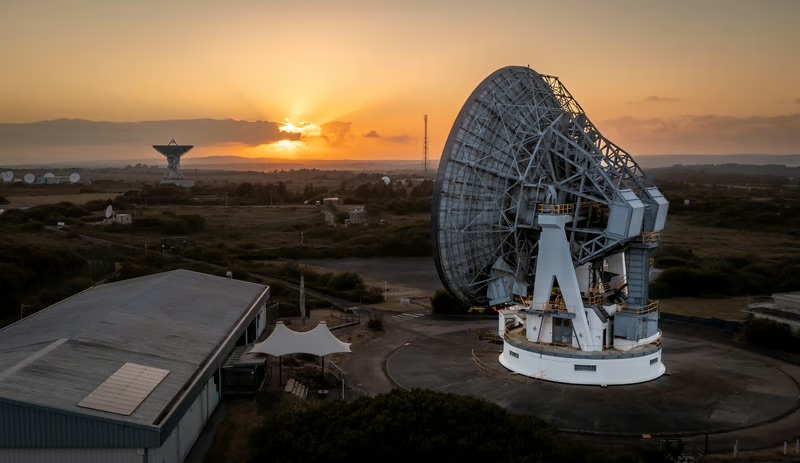

Why does space workforce development matter as much as the technology itself? Satellites eventually need to be replaced, but the expertise developed by engineers, analysts, regulators, policymakers, managers, and other professionals can strengthen a country’s capabilities for decades. Angola’s experience demonstrates why workforce development needs to grow alongside investments in space infrastructure.
Building that workforce also means looking beyond aerospace engineering. The modern space economy needs expertise in GIS, data science, software, cybersecurity, telecommunications, policy, law, business, and other disciplines. Through initiatives such as Angola’s National Certification Program, GEDAE, and international partnerships, the country is building a broader talent pipeline capable of turning space investments into useful services and long-term national capability.
Every satellite has a working life, and eventually, it will be upgraded, replaced, or retired.
But even as the technology changes, the knowledge held by the people who designed, operated, managed, regulated, and applied that system can continue serving the country long after the hardware changes.
“People are the most important investment any country can make. Satellites can be replaced, but the knowledge, skills, and experience of the people behind them can’t.”
That principle has influenced how I think about Angola’s development in space science and the wider space economy. Technical infrastructure is significant, but countries also need people and institutions capable of operating, improving, and regulating systems, building services around them, and connecting those services to national priorities.
For young people considering careers in space, it’s important to know that the industry is much broader than spacecraft engineering. Some of its most consequential work occurs after a satellite is operational, when professionals translate technical capabilities into services used by governments, companies, schools, clinics, and communities.
Hardware may give a country access to these capabilities, but it’s the people who determine what happens with it.
Why Do People Matter More Than Technology in the Space Economy?
Every satellite program depends on human expertise before launches can even be thought about.
Think about this:
- Someone defines the requirements.
- Someone negotiates procurement.
- Engineers learn the system.
- Operators manage it.
- Regulators coordinate the spectrum.
- Analysts interpret information.
Public institutions work out how the resulting services fit into existing operations. Commercial teams determine whether a viable market exists. Remove those people, and sophisticated hardware quickly becomes underused hardware.
I witnessed this as Angola expanded its national space capability. Every technical project also became a training ground. Angolan professionals learned how complex programs are structured, how international suppliers work, how operational problems are handled, and where satellite-enabled services can address national needs.
And this experience didn’t disappear when one phase of the project ended.
An engineer who works through an operational problem carries that lesson into the next mission. A manager who has dealt with an international procurement brings that experience into the next negotiation. A geospatial analyst can apply the same technical foundation to agriculture, mining, drought monitoring, urban planning, or environmental oversight.
That’s why I see human capital as such a strategic asset. The technology supporting space careers will continue changing, but professionals who know how to learn, adapt, and work across systems give a country the ability to change with it.
What Does It Really Take to Build a Sustainable Space Workforce?
You can’t create an experienced space workforce a few months before a major project becomes operational. It has to be developed years earlier.
Students need strong foundations in mathematics, science, computing, geography, engineering, policy, and economics. Universities need instructors who understand current systems, research programs connected to practical problems, and relationships with the institutions actually operating space-enabled services.
Young professionals also need access to real work.
There’s a major difference between studying a satellite system and being responsible for one. Operational environments force people to work through uncertainty, budget constraints, time pressure, technical failures, competing priorities, and coordination across institutions. Those hands-on experiences are where the real learning happens.
Additionally, mentorship gives younger professionals access to that experience earlier.
Continuous training matters because space careers and technology are rapidly evolving. AI is changing geospatial analysis. Commercial satellite models are changing procurement. New communications architectures are changing network operations. International standards are evolving as more countries and companies enter the sector.
So, training can’t be treated as a workshop attached to a project. It has to become part of how institutions operate.
Angola’s National Certification Program for Managers and Users of Space Technologies is an example of that approach. Through the program, we trained 148 professionals across Angola’s provinces, with more than 70 certified through the National Certification Program, creating a national network of people capable of understanding and applying space-enabled tools.
I see these Space Technology Champions as an important bridge between national capability and local use. They’re positioned to bring satellite-enabled services into institutional workflows, including rural and underserved areas where planning, access, and public service delivery are often most challenging.
And that’s exactly what a talent pipeline should do: connect national investments with people who can make them useful on a local scale.
Why Does the Space Economy Need More Than Engineers?
When I meet young people interested in space careers, I still hear the assumption that aerospace engineering is the only serious route into the industry.
It’s certainly an option, but it’s not the only one.
Consider Earth observation. Engineers may build and operate the satellite, but data scientists are needed to process large datasets. GIS specialists interpret geographic patterns. Environmental professionals connect those patterns to conditions on the ground. Economists can assess fiscal consequences. Lawyers handle contracts and regulatory questions. Software developers build usable platforms. Policymakers decide how government agencies incorporate the information. There’s a vast web of roles and opportunities outside of traditional engineering.
Communications systems require another mix of expertise, including telecommunications engineers, spectrum specialists, cybersecurity professionals, local ISPs, business development teams, financial analysts, project managers, and regulators who understand the communities they serve.
The modern space economy depends on people who can connect technical capabilities with real needs.
How Has Angola Built Space Talent Alongside National Capability?
Angola’s experience has convinced me that national capability and workforce development have to grow together.
Take GEDAE, for example. The value of GEDAE isn’t simply access to geospatial systems. It’s the operational knowledge built around those systems.
Property identification requires professionals who understand imagery, databases, mapping, and public administration. Land-use monitoring requires people who can interpret geographic change and connect it to government planning. Mining oversight requires technical specialists who understand both the data and the policy consequences.
A professional trained in geospatial analysis may begin with land management and later work in agriculture, environmental monitoring, infrastructure planning, disaster response, or commercial analytics. The technical foundation remains relevant even as the application changes.
That’s also why the National Certification Program is so important not only to me but also to the people it serves.
“Developing space careers can’t be limited to specialists working inside a national space agency. Managers and users throughout government need enough technical understanding to identify where satellite services can improve their own work.”
The strongest outcome is when a trained professional begins operating a system, develops an application, improves an institutional process, or teaches someone else to do the work.
At that point, knowledge starts multiplying.
What Can International Partnerships Contribute Beyond Technology Transfer?
Partnerships have also played an important role in Angola’s development, but I judge them by what remains after the formal engagement ends.
Our collaboration with the MIT Media Lab and broader engagement with international institutions have provided opportunities for technical exposure, research, knowledge exchange, and new approaches to problem-solving.
The same principle applies to relationships with organizations such as NASA, Airbus, ITSO, UNOOSA, African space agencies, and commercial space companies. Partnerships become demonstrably valuable when they transfer standards, operating knowledge, technical exposure, and market access, not just hardware.
For me, a useful question I use to judge these engagements is: What can our professionals do after this partnership that they couldn’t do before it?
Those outcomes impact the future of space careers because international exposure can also show young professionals how broad the industry actually is. A student studying law may discover spectrum regulation or international space governance. A software engineer may move into geospatial analytics. An economist may find a role in satellite-service markets.
Bottom line, the best and most impactful partnerships increase both national capability and professional possibility.
How Do Strong Institutions Multiply the Value of Space Investments?
People need places where their knowledge can be applied, tested, and passed on. That’s the role of institutions. Universities preserve research capability, and government agencies accumulate policy and operational experience. Technical centers enable specialists to work across disciplines, and private companies create markets where technical expertise becomes a commercial service.
Strong institutions also prevent knowledge from disappearing every time a project ends.
A satellite may operate for a decade or more. A particular international partnership may last a few years. A well-run institution can carry lessons from both into the next generation of programs.
Professionals need opportunities to continue learning. Institutions need connections to universities, commercial companies, government users, and international partners so expertise continues moving through the ecosystem.
Similarly, leadership also deserves more attention.
Operating a technical system and leading a national program require different skills. Future leaders need experience with budgets, procurement, policy, personnel, international negotiations, risk, and long-range planning beyond just industry-specific knowledge.
If countries want national space capability to survive individual projects, they have to develop people capable of leading the organizations responsible for it.
What Lessons Can Emerging Space Nations Learn from Angola’s Experience?
“If I were advising a country beginning its own space program, I would encourage it to plan workforce development alongside infrastructure. Don’t buy the system first and then ask who’s going to operate it.”
Map the skills that already exist. Identify what’s missing. Decide which expertise must be developed nationally and where international partners can help close temporary gaps. Bring universities into the process early and give young professionals access to operating environments. Create stronger pathways between government, academia, and industry.
For example, if agriculture is a major application, develop professionals who understand both agriculture and geospatial technology. If connectivity is the priority, build expertise in telecommunications, spectrum coordination, network operations, regulation, commercial services, and local ISP development. And if climate resilience matters most, environmental scientists belong in the workforce strategy right alongside the engineers.
What Will Tomorrow’s Most Valuable Space Careers Look Like?
I expect the next generation of space professionals to work across disciplines much more frequently than previous generations did.
AI will create demand for people who understand both machine learning and geospatial information. Earth observation will need specialists capable of connecting imagery with climate science, agriculture, insurance, economics, and public policy.
Satellite communications will increasingly intersect with cybersecurity, fintech, enterprise connectivity, and digital services. Commercial space will require people who understand technology and markets.
The emerging lunar economy will add another layer. Communications, navigation, standards, robotics, logistics, data systems, law, policy, and mission operations will all create new paths into space careers. Africa doesn’t have to wait for a launch vehicle or astronaut program to begin preparing for those roles.
The important thing is to develop people who can learn across boundaries, and those professionals will be difficult to replace.
The Investment That Outlives the Satellite
Satellites are important, but so are ground systems, communications networks, Earth observation platforms, and data centers. Every technical asset eventually reaches the end of its useful life, in which case it’s up to people to carry their knowledge and experiences into whatever comes next.
The engineer remembers how a system failed and how the team fixed it. The analyst improves an application after seeing how institutions actually use it. The policymaker enters the next negotiation with experience from the previous one. The educator passes knowledge to another generation. The entrepreneur builds new commercial services around capabilities that national investments helped create.
Institutions give that experience somewhere to accumulate.
Angola’s work through GEDAE, the National Certification Program, collaboration with the MIT Media Lab, and broader partnerships has reinforced what I have believed throughout this journey.
Looking into the future, it’s less valuable to look at how many satellites a country has placed in orbit. Instead, I want to know what people can now accomplish because of those space investments, because it’s up to the people to determine how far those investments truly go.
Frequently Asked Questions (FAQs)
1. Why is human capital so important to a national space program?
Because satellites and technical systems eventually need to be replaced, while skilled professionals and strong institutions continue creating value over time. Engineers, analysts, policymakers, educators, lawyers, entrepreneurs, and operators all contribute to turning satellite capability into useful services.
2. Do you need to be an engineer to build a career in the space economy?
No. Modern space careers include data science, GIS, telecommunications, cybersecurity, law, economics, policy, project management, education, environmental science, and business development. The space economy increasingly needs people who can connect technical systems to practical economic and public-service outcomes.
3. How can governments build a sustainable space workforce?
Workforce development should begin years before major projects come online. Governments can support scholarships, university partnerships, apprenticeships, professional certification, operational training, mentorship, and international exchanges that give professionals experience working with real systems.
4. What role do international partnerships play in workforce development?
The strongest partnerships transfer more than technology. They expose local professionals to international standards, operating practices, research environments, procurement processes, and commercial networks. Over time, that should increase a country’s ability to operate and develop its own capabilities.
5. How can African countries create more value from space careers?
Countries can connect workforce development directly to national demand. That means training people for Earth observation analytics, communications services, ground systems, spectrum management, agriculture, climate resilience, digital infrastructure, government applications, and commercial services where space-enabled capabilities are already needed.